Kingman High Desert Survival Hacks for Your Air Conditioner
Why Kingman’s high desert pushes AC systems to the edge
Kingman sits at roughly 3,330 feet above sea level. The air is thinner than Phoenix and far drier than coastal markets. In July and August, outdoor temperatures around a home’s condenser often sit between 105 and 115 degrees through late afternoon. Under those conditions, an air conditioner’s compressor, condenser coil, and fan motor must move more heat with less-dense air. That combination shortens component life if the system is not sized and maintained for desert duty.
Homes along Route 66 and the Andy Devine Avenue corridor take direct western sun from mid-afternoon to sunset. Roof surfaces radiate heat back into attics, where supply trunks and return plenums can see 130 to 150 degrees. Duct leaks and high static pressure waste capacity exactly when the grid is busiest and utility rates rise. That is why a system that seemed fine in May shows weak cooling or short cycling by the first July heat wave.
Many properties in White Cliffs, Hilltop, and New Kingman-Butler use packaged rooftop units. Packaged units cool well in dry air but take the worst heat on the roof deck. The condenser fan lives in a 110-degree airstream and the control compartment bakes. Run capacitors and contactors in those cabinets run hotter and fail earlier than the same parts in shaded ground-mounted split systems in the Hualapai Mountain area. That is normal for the region, not a sign of a bad brand.
A technical truth Kingman homeowners rarely hear
Capacity drops at elevation. At 3,300 feet, air density is roughly 10 percent lower than at sea level. In real terms, a 3-ton central air conditioner that delivers close to full capacity in coastal conditions can deliver 5 to 10 percent less sensible cooling capacity on a 110-degree Kingman afternoon, before any losses from dirty coils or duct leaks. Ambient Edge technicians regularly see condensing saturation temperatures 10 to 15 degrees higher on rooftop packaged units during Mohave County heat waves than on similar systems in cooler markets. That shift is expected physics and a key reason correct airflow, superheat, and subcooling targets matter more here than a simple nameplate tonnage.
This is the kind of detail local publications and real estate blogs often miss when comparing homes by square footage alone. Orientation, window area facing west toward Locomotive Park or the Mohave Museum of History and Arts, and duct layout above a 140-degree ceiling cavity can swing effective capacity in ways a listing sheet cannot show.
High desert stress points that cause calls for air conditioning repair
Heat, elevation, dust, and hard water intersect to create predictable fault patterns. In the 86401 and 86409 zip codes, the most common failures during the first monsoon dust events are capacitor failure, contactor pitting, and blocked condenser coils. Fine dust and cottonwood fluff get pulled tight against the condenser coil’s outer fins. Airflow across the condenser drops, head pressure climbs, and the compressor trips on thermal overload. That sequence looks like AC short cycling, but the root cause is airflow starvation at the coil, not a thermostat malfunction.
Inside the home, low humidity and long runtimes can freeze an evaporator coil if airflow is weak. Weak airflow can come from a dirty air filter, a failing blower motor, or a high static pressure duct system common in older Hilltop and Valle Vista homes that were retrofitted for modern central air without re-sizing the ducts. When an evaporator coil ices, supply vents push little to no air and the thermostat falls behind several degrees. Shutting the system off may thaw the coil but the underlying airflow or refrigerant charge problem remains and will refreeze under the next load spike.
Condensate problems are a quiet threat in Kingman. The water that drains off a cold evaporator coil carries dust and minerals into the condensate line. In houses near the Kingman Regional Medical Center and Arizona Western College Mohave Campus, technicians often find algae and scale narrowing lines after the first sustained humidity bump of monsoon season. A clogged condensate drain triggers a float switch that shuts the system down to protect ceilings. Homeowners report the unit will not turn on or that it runs but then cuts off within minutes with no cool air delivered.
Rooftop packaged units vs. Split systems in Kingman
Packaged units dominate older structures along Andy Devine Avenue and many commercial storefronts near Route 66. These units combine the compressor, condenser coil, evaporator coil, and blower in one cabinet. Service access is fast and a crane can place a new unit without touching interior drywall. The trade-off is heat. A packaged unit’s blower motor and control board spend their life in the same hot enclosure as the compressor. Capacitors, contactors, and fan motors see higher average cabinet temperatures, so preventive AC maintenance with electrical testing is vital in June before July’s first triple-digit week.
Split systems are more common in newer subdivisions near Hualapai Mountain Park and out toward Golden Valley. The outdoor unit sits on the ground and the air handler lives in a closet or garage. Splits run cooler on the electrical side and often see longer contactor and capacitor life. But split systems depend on ductwork that runs through tight attic spaces. Improper duct sizing and kinks under trusses push static pressure up. As pressure rises, airflow falls, the evaporator coil gets colder, and the risk of a Frozen AC Unit goes up on peak days.
Refrigerant behavior in dry heat and what it means for charge
Most central systems in Kingman run Refrigerant R-410A. New equipment arriving from many brands will begin to use Refrigerant R-454B as phasedown schedules move forward. Legacy systems still exist with R-22. Charge strategy in high heat and low humidity is not guesswork. Technicians check superheat and subcooling while watching liquid and suction line temperature and pressure. On a 110-degree day near Kingman Airport, long line sets on homes outside Butler can develop extra pressure drop. When that happens, the system may appear low on charge based on suction pressure, but the actual root cause can be a restriction at the TXV Valve, a partially collapsed filter-drier, or a matted condenser coil forcing head pressure up and skewing the numbers.
A correct diagnosis requires gauges, line temperature probes, and familiarity with brand-specific charging charts on Trane, Lennox, Carrier, Goodman, Rheem, York, Daikin, and Mitsubishi Electric. Recharging refrigerant without verifying airflow and coil condition wastes money and can mask a Refrigerant Leak that will return as Warm Air from Vents during the next heat spike.
Ductwork realities above 140-degree attics
Mohave County’s building stock includes homes built in the 1970s through 1990s with retrofit ductwork that was never sealed or sized for today’s higher efficiency units. Duct leaks in an attic do two things that matter on a 112-degree afternoon. First, they bleed cold air into the attic, so rooms farthest from the air handler get Low Airflow and never hit the thermostat setpoint. Second, they draw superheated attic air into the return path, which raises the coil load and lengthens runtime. That pattern shows up as a High Electricity Bill every August.
Ambient Edge technicians measure total external static pressure and compare it to the air handler’s rating. Pressures above about 0.5 inches of water column on many residential blowers indicate a restriction. Common fixes in Kingman include opening undersized returns in homes near White Cliffs, sealing panned returns found in older Hilltop homes, and replacing crushed flex duct after a roofing job on the Andy Devine corridor. Correcting static pressure often eliminates AC short cycling, reduces compressor stress, and restores full tonnage without touching the refrigeration circuit.
Electrical parts that fail faster in Kingman heat
Capacitor Failure leads every July service board in 86401 and 86409. A run capacitor degrades faster when cabinet temperatures stay high late into the night. When a capacitor drops below spec, the Compressor or condenser fan motor will hum, then shut down on thermal protection within seconds of starting. Contactor welding and pitted points follow close behind in rooftop packaged units because contactors open and close under higher load in hot conditions.
Blower Motor Failure shows up when static pressure is high or filter changes were missed at the start of summer. An overworked blower draws extra current and overheats. Bearings dry out faster under attic heat. A failed motor reduces coil temperature and starts the ice-fall-thaw loop that costs a full day of cooling on a weekend.
Compressor Failure is less common than homeowners fear. More compressor trips look like failure but reset after the root cause is addressed. Overheated windings from a clogged condenser or off-spec capacitor will mimic a locked rotor. Verifying current draw, winding resistance, and megohm insulation to ground prevents unnecessary replacement.
Moisture, dust, and Kingman water: how they affect drains and coils
Low ambient humidity means latent load is modest, but condensate still forms on the evaporator coil whenever the coil temperature drops below the dew point of return air. The water washes dust into the Drain Pan and Condensate Line. Hard water minerals in Kingman leave scale at the trap, and algae grows when monsoon humidity arrives. A Clogged Condensate Drain trips float switches in the pan or auxiliary pan. That safety does its job and shuts the system down. The homeowner hears the indoor fan stop, the thermostat shows a call for cooling, and the system seems dead without any Strange AC Noises to guide a guess.
On the outdoor side, cottonwood and desert dust turn clean condenser fins into felt. A condenser clogged by spring allergens can add 50 to 100 psi to head pressure by July. That is enough to push Refrigerant R-410A discharge temperatures above safe compressor limits and cause nuisance trips every afternoon. In neighborhoods near Locomotive Park, a dusty wind after a storm can cut heat rejection efficiency the next day by double digits. That is why coil condition is the first thing a local tech checks before adjusting refrigerant charge.
Heat pumps in the high desert and what changes when winter arrives
Heat pumps handle most winter days in Kingman without auxiliary heat. The balance point is higher in homes with duct runs through cold attics above the White Cliffs area. In January nights with desert radiational cooling, defrost cycles can lengthen and homeowners may notice brief periods of warmer supply air followed by cool air as the Reversing Valve shifts. An undersized heat pump will hold temperature but run long, raising electric bills in 86413 and Golden Valley. Dual-fuel systems with a Gas Furnace as backup are common near Hualapai Mountain neighborhoods where elevation and wind raise heat loss.
Commercial cooling along Route 66 and the Andy Devine corridor
Restaurants, offices, and retail along Route 66 and Andy Devine Avenue rely on packaged rooftop units that fight kitchen heat, long glass storefronts, and door traffic. Economizers may be locked out in summer, but they still need calibration for shoulder seasons. Dirty filters and broken economizer dampers are a top culprit for Warm Air from Vents complaints in emergency ac repair April and May. In July, the pattern shifts to short cycling on high head pressure due to clogged condenser coils and fan belts that slip under heat. A service visit that sets belt tension, cleans coils, verifies TXV bulb contact, and checks the Contactor and Capacitor saves owners a mid-shift shutdown.
What makes a Kingman-ready AC check different
A proper AC Maintenance visit in Mohave County goes beyond a quick rinse of the outdoor unit. Technicians document baseline static pressure, confirm blower tap settings against target CFM, and measure coil temperature split under stabilized conditions. On packaged units, they check cabinet gaskets that leak hot air into the return path. They test the Capacitor with a capacitance meter, not just a visual check. They inspect the Condenser Coil for embedded dust that a hose will not remove and use the proper cleaner when needed. They clear the Condensate Line at the trap and verify float switch operation. They scan electrical connections for heat discoloration that predicts Contactor failure later in July. They record superheat and subcooling and compare them to the brand’s charging chart at the day’s actual outdoor temperature.
For homeowners in Valle Vista and South Kingman, these checks are not an upsell. They are the difference between cruising through a 112-degree week and calling for Emergency AC Repair at 8 PM on a Sunday. The high desert does not forgive deferred maintenance when the grid and your system are both near their limits.
Signals that demand a same-day service call during a heat wave
When heat pushes outdoor readings past 108 degrees, certain symptoms should not wait. Acting early prevents larger failures and shorter equipment life.
- Outdoor unit hums but the fan blade does not spin or starts then stops within seconds. Supply vents blow warm or room-temperature air for more than 10 minutes with the compressor running. Ice on the refrigerant line at the air handler or a wet filter slot after thaw. Water near the indoor unit, a full Drain Pan, or a system that will not run with a lit thermostat. AC short cycling: unit starts and stops every few minutes without reaching setpoint.
Brands and components seen daily across Mohave County
Ambient Edge services and installs equipment from Trane, Lennox, Carrier, Goodman, Rheem, York, Daikin, and Mitsubishi Electric. The team diagnoses faults at the component level: a weak Capacitor that measures 20 percent below rated microfarads, a pitted Contactor that arcs under load, a Blower Motor with failing bearings drawing above nameplate amps, a TXV Valve with poor bulb contact causing erratic superheat, or a Refrigerant Line kinked during a landscaping project at a Route 66 storefront. Identifying the exact failure prevents repeat issues and restores full design performance.
Why west-facing homes run hot late into the evening
Homes near the Mohave County Fairgrounds and along the Route 66 corridor often have west and southwest exposures that absorb sun until sunset. Walls, patios, and driveways re-radiate heat into the structure and the outdoor unit’s surrounding air. A Condenser Coil rejecting heat into 112-degree air in a side yard walled on three sides will run higher head pressures than the same unit in an open yard near Hualapai Mountain Park. If the yard wall blocks the prevailing breeze, the Condenser Fan must do all the work. Clearance around the unit matters in Kingman more than in milder climates.
Kingman’s elevation changes blower settings and thermostat choices
Air density at 3,300 feet reduces mass flow through the blower for the same RPM and static pressure. Many factory default blower tap settings assume sea-level density. In practice, that means a Split System in White Cliffs could be moving less CFM than the air handler chart suggests. A NATE-certified technician will verify delivered airflow with static pressure and temperature rise or a flow grid. They will adjust blower speed to hit the target CFM per ton needed for a dry climate, which is often higher than in humid markets to maximize sensible capacity.
Smart Thermostats and Programmable Thermostats help if programmed for Kingman’s daily temperature swing. Pre-cooling strategies before peak rate windows can drop interior mass temperature, flattening late-afternoon demand. This is not a tutorial. It points to the reality that control strategy and airflow setup have a measurable impact on comfort and bills in Mohave County.
Service coverage with true local familiarity
Ambient Edge supports homes and businesses throughout Kingman and Mohave County, including 86401, 86402, 86409, and 86413. Calls come from Downtown Kingman, White Cliffs, Hilltop, New Kingman-Butler, Valle Vista, the Hualapai Mountain area, and the Locomotive Park area. The team also handles air conditioning repair in Golden Valley, Fort Mohave, and Mohave Valley, and supports commercial and residential systems from Bullhead City to Lake Havasu City, with Laughlin, NV on the river corridor.
The dispatch team understands how afternoon shade from the Hualapai foothills changes load near Hualapai Mountain Park and how wind exposure on open lots east of Kingman Airport affects rooftop packaged unit performance. That local knowledge shortens diagnosis and gets cooling back online faster on the hottest days.
Common root causes logged in July service calls across Kingman
Patterns emerge each season. The list below reflects what technicians document most during the first extended heat wave in Mohave County.
- Capacitor Failure in rooftop packaged units serving storefronts along Andy Devine Avenue. Dirty Condenser Coil on ground-mounted units in Route 66 neighborhoods after dust events. Clogged Condensate Line in homes near Kingman Regional Medical Center when monsoon humidity rises. Ductwork Leak and high static pressure in retrofitted Hilltop and White Cliffs properties. Thermostat Malfunction from non-isolated 24V wiring splices in hot attics exceeding 140 degrees.
What “fixed right” looks like in Mohave County terms
Restoring cooling on a 112-degree afternoon is step one. Step two is verifying that the root cause will not return when the next heat wave hits. In Kingman, that means cleaning the Condenser Coil through the fins, not just rinsing the top. It means measuring and documenting capacitance, contactor voltage drop, and compressor amp draw under load. It means clearing the Condensate Line at the trap and confirming float switches open the control circuit. It means checking duct leakage with a smoke pencil at suspect joints and measuring static pressure on both sides of the Air Handler. It means charging by superheat and subcooling to the manufacturer’s target for that exact outdoor temperature.
For Commercial HVAC systems on Route 66, it also means verifying economizer position, inspecting belts, and confirming the TXV sensing bulb is tight and insulated. For Heat Pump systems in Valle Vista, it means confirming Reversing Valve operation and that defrost control is configured for desert conditions.
Local insight that saves real money
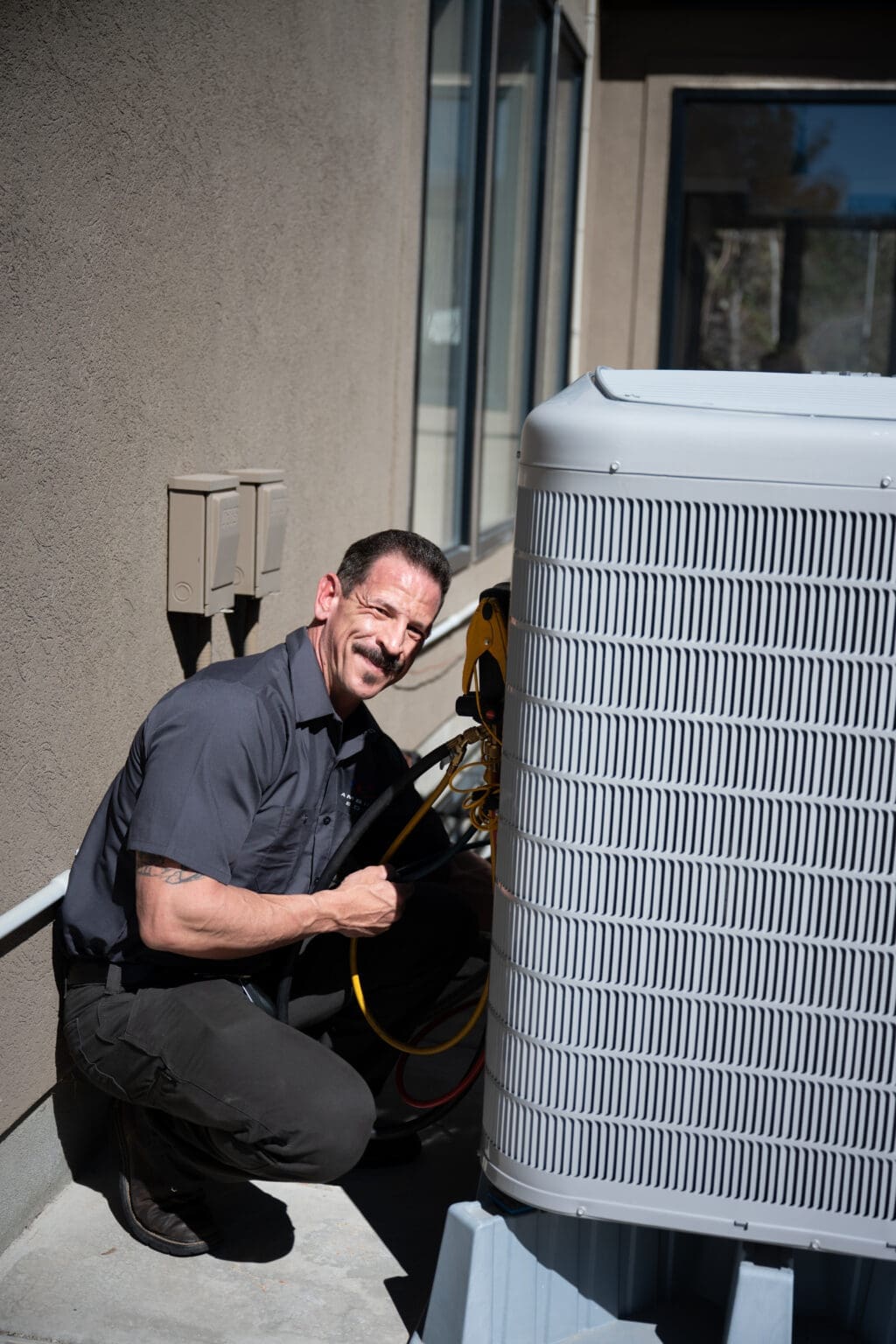
A west-facing condenser sitting inside a narrow masonry enclosure behind a Hilltop home can run 30 to 60 psi higher head pressure than the same model in an open yard in Valle Vista. That pressure rise can draw 1 to 3 extra amps through the Compressor on a 3-ton system. Over a high-heat month, that adds up on a residential bill. The solution is not exotic equipment. It is better airflow around the unit and a clean Condenser Coil. This kind of on-site judgment, learned on Mohave County jobs, separates a stopgap air conditioning repair from a fix that holds up under real Kingman heat.
Residential and commercial systems we service and install
Ambient Edge works on Central Air Conditioners, Split Systems, Packaged Units, Ductless Mini Splits, and Heat Pumps. The team handles Furnace Repair for Gas Furnace and Electric Furnace systems, Heat Pump Repair and Heat Pump Installation, and Ductless Mini Split Installation for additions and detached shops common outside the city center. For Indoor Air Quality, technicians install Whole-House Dehumidifiers when needed for river-adjacent climates in Fort Mohave and Mohave Valley. Technicians also address Duct Cleaning requests when dust loads impair coil performance.
On the plumbing side, crews handle Plumbing Repair, Water Heater Installation, and Tankless Water Heater work. That matters for properties seeking a single point of responsibility for comfort systems in and around Kingman.
Why quick fixes fail during the next heat wave
Replacing a Capacitor that failed on a 112-degree day will get the compressor running, but if the Condenser Coil is loaded with dust and cottonwood and the Contactor is pitted, the replacement capacitor works harder and fails again within weeks. Adding Refrigerant R-410A to a system delivering Warm Air from Vents without verifying airflow can hide a Ductwork Leak or a weak Blower Motor. The unit cools slightly better until the next triple-digit day, then falls behind again. A lasting repair in Kingman checks airflow, coil condition, electrical health, and refrigerant charge as a system, not as isolated parts.
Local shareable stat for Kingman homeowners
Ambient Edge technicians regularly measure attic temperatures in Kingman of 130 to 150 degrees between 2 PM and 6 PM during July. At those attic temperatures, a 20-foot run of uninsulated or poorly sealed supply duct can pick up 6 to 10 degrees before the air reaches the register. In a White Cliffs ranch with a single long branch to a west bedroom, that loss alone explains why rooms at the end of the line never feel cool after 4 PM even when the system is “working.” Sealing and insulating that run often reduces room temperature by several annual air conditioning service degrees without changing the equipment.
How Kingman’s grid and rate windows shape cooling strategy
Late afternoon is the most punishing time for systems in Downtown Kingman, the Locomotive Park area, and neighborhoods south toward the Mohave County Fairgrounds. Outdoor air temps, roof heat soak, and utility rate windows stack. Systems that pre-cool the building envelope earlier in the day can ride through the peak with steadier coil load and fewer compressor starts. That reduces AC short cycling, keeps refrigerant oil where it belongs in the compressor, and can extend Compressor life. Technicians who understand this local pattern set blower speeds and thermostat programs accordingly when homeowners ask for help smoothing late-day comfort.
Kingman-ready installation standards
When installing new equipment, the team sizes by Manual J heat gain calculation rather than rules of thumb. West-facing glass near Route 66, ceiling insulation R-values common in 1980s homes in Hilltop, and outdoor unit placement in walled side yards factor into the load. SEER2 ratings matter, but coil surface area, fan capability at higher static pressures, and a condenser that holds capacity in 110-degree air are just as important here. Installers set charge by weight and verify with superheat and subcooling at Kingman’s actual outdoor temperature. They confirm total external static pressure and adjust the blower to hit target CFM per ton for dry-climate sensible capacity.
For Ductless Mini Split systems serving additions in Golden Valley and Butler, lineset length, flare quality, and outdoor unit clearances get extra attention because wind-blown dust can pack against fins if clearances are tight. For Commercial HVAC, curb adaptors are sealed to prevent hot roof air from entering the return, a frequent miss that drags performance down on packaged units.
A note on refrigerant transitions
As R-410A systems phase out in favor of R-454B on many models, service procedures and gauges change. Ambient Edge maintains EPA 608 Certified technicians trained for emerging refrigerants. For homeowners in 86401 and 86409 with R-22 equipment still cooling, the team advises on realistic repair versus replacement decisions under current refrigerant availability and cost. The goal is to keep you cool through a Kingman summer with the lowest total ownership cost, whether that means a targeted repair now or planning a system replacement before the next peak season.
Coverage tied to real places, not a map line
Service trucks roll across Kingman daily: Downtown, White Cliffs, Hilltop, New Kingman-Butler, Valle Vista, and the Hualapai Mountain area. Calls come from homes near the Mohave Museum of History and Arts, the Andy Devine Avenue corridor, Kingman Airport, and neighborhoods edging Hualapai Mountain Park. The same crews handle homes and shops in Golden Valley, Fort Mohave, and Mohave Valley. Whether the system is a Lennox split in a 1990s Hilltop home or a Goodman packaged unit above a Route 66 storefront, the team has seen the failure pattern before and carries the parts to finish most repairs in one visit.
Ready when the heat hits: scheduling and response
During the first major heat spike, call volume doubles across Mohave County. Ambient Edge staggers shifts and increases parts stock for Capacitors, Contactors, blower motors, and TXV kits to keep trucks ready for same-day AC Repair and HVAC Repair calls. The dispatch team triages AC Not Cooling and safety issues like water at the Air Handler ahead of routine AC Maintenance. That approach keeps the most vulnerable homes and businesses online during a heat event.
Service details for homeowners and property managers
Every repair begins with a clear diagnosis. Technicians document measured values before and after work. Air Conditioning Repair includes electrical checks, coil condition assessment, airflow verification, and refrigerant circuit testing as needed. For property managers along Route 66 and near Kingman Regional Medical Center, reports summarize findings so owners can plan capital improvements around the actual system condition.
For installations, the team handles Air Conditioning Installation, Heat Pump Installation, and system design details like return sizing to hit static pressure targets. Financing options are available for qualified projects. Maintenance plans cover HVAC Maintenance for residential and Commercial HVAC clients, with scheduled visits before peak summer and winter seasons.
Why local expertise matters more than brand myths
Brand debates miss the point in Mohave County. Trane, Lennox, Carrier, Goodman, Rheem, York, Daikin, and Mitsubishi Electric all build equipment that can cool a Kingman home well when installed and set up for high temperature and elevation. The difference homeowners feel on a 112-degree day is airflow, charge set by measured targets, clean heat exchangers, and solid electrical parts. The technicians who touch systems daily in 86401 and 86409 know which failure mode to test first because they have seen it dozens of times that month in the same weather pattern.
Ambient Edge: the quiet advantage in Kingman heat
Ambient Edge serves Kingman and Mohave County all summer, all night, and all year: 24 hours a day, 7 days a week, 365 days a year. The team provides Emergency AC Repair, AC Repair, HVAC Repair, AC Maintenance, and HVAC Maintenance for residential and Commercial HVAC systems. Every call receives flat-rate pricing in writing before work begins. NATE-certified technicians arrive with stocked parts to finish most jobs on the first visit. For new systems, installations come with strong manufacturer warranties and workmanship coverage aligned with brand requirements. Ambient Edge is an Arizona ROC licensed HVAC contractor committed to clean, code-compliant work.
Call (833) 226-8006 for 24/7 emergency service in Kingman, including 86401, 86402, 86409, and 86413. Or visit https://www.ambientedge.com/kingman/ to schedule AC service, request a quote for replacement, or set up a maintenance plan.
Ambient Edge Heating, Air Conditioning & Refrigeration Inc.
Our Location:
3270 Kino Ave,
Kingman,
AZ
86409
Phone: +1 928-615-8224
Web: www.ambientedge.com